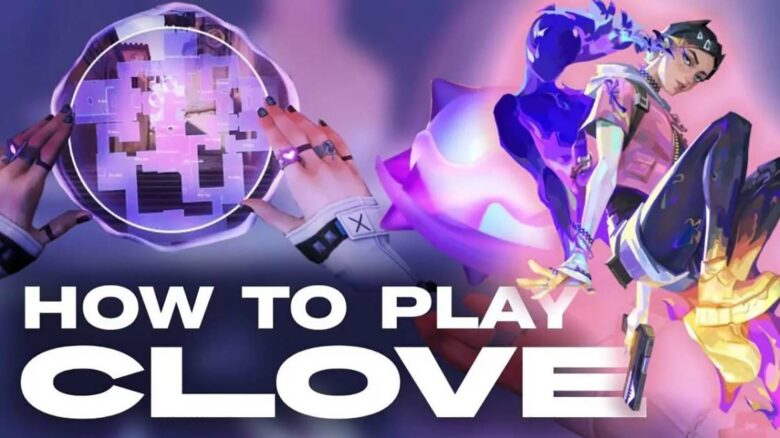
Clove stands out in VALORANT’s controller lineup by letting you stay involved even after you fall. You can deploy smokes post-death, heal yourself through kills, and activate an ultimate that brings you back into the round, which rewards confident, forward play.
If you prefer to take space and pressure fights rather than anchor from the backline, Clove fits that style well in ranked. While professional teams often favor controllers with longer-lasting and more team-focused utility, you can still use Clove effectively when you understand their limits and play around their shorter smokes and self-centered tools.
Clove Abilities: What Does Clove Do?
Clove’s toolkit centers on risk and recovery. You pressure space with decay, block vision even after you fall, gain temporary health and speed from fights, and can return to life if you convert a post-revive duel.
The design blends controller utility with duelist momentum. You must take calculated fights to unlock full value.
Meddle (Q) – 250 Credits, One Use Each Round
Type: Area decay
Cost: 250 credits
Charges: 1 per round
You throw an energy fragment that lands and detonates after a short delay. Enemies inside its radius suffer Decay, temporarily reducing their maximum health by up to 90 HP before it restores over time.
This effect requires line of sight at detonation. Anyone exposed within the area takes the reduction, including teammates, so call it before you throw.
What this means in practice:
- A fully healthy enemy can drop to very low effective HP.
- Most rifles and many sidearms can secure a fast follow-up kill.
- Timing matters more than precision lineups.
Use it to force defenders off angles, punish common anchor spots, or soften targets before a coordinated swing. Because the effect fades, you should push while the decay is active rather than waiting.
You gain the most value when your team trades immediately after it bursts.
Ruse (E) – Signature Smoke (1 Free Charge; Second Costs 150 Credits; Usable After Death)
Type: Deployable smoke
Base Charge: 1 free
Additional Charge: 150 credits
Duration: ~13.5 seconds
Cooldown: Recharge over time
You open a tactical placement view and drop smoke clouds onto selected areas. The interface functions similarly to other map-based controllers, letting you block key sightlines quickly.
The defining trait is post-death utility. After you die, you can still deploy a smoke charge, but:
- You can place only one while dead.
- The placement range is limited to the area near your body.
This mechanic changes how you position during executes and retakes. If you fall deep in enemy territory, your post-death smoke likely benefits that zone. If you die far from the objective, your impact shrinks.
Key considerations:
| Factor | Impact on Round |
|---|---|
| Short duration (~13.5s) | Requires timely pushes |
| Recharge mechanic | Enables mid-round adjustments |
| Post-death placement limit | Rewards smart positioning before fights |
Your smokes do not last as long as some other controllers’ tools. You cannot stall indefinitely. Instead, you create short, controlled windows to take space, plant, or isolate duels.
Treat your life as part of the setup. Where you fall can still shape the round.
Pick Me Up (C) – 200 Credits, Triggered on Kill or Damaging Assist
Type: Self-buff
Cost: 200 credits
Effect: Temporary overheal + movement speed
After you secure a kill or contribute damage to an enemy who dies, you can activate this ability to absorb energy from them. You gain:
- 50 HP temporary overheal
- A brief movement speed boost
- Up to 8 seconds of overheal duration
The overheal does not last forever. If you do not take further damage, it fades after the timer ends.
This ability pushes you to stay involved in engagements. You must either eliminate the opponent or meaningfully assist in their takedown. Passive backline play limits your access to this resource.
How it changes fights:
- You can take an immediate second duel with extra HP.
- You can reposition quickly after a frag.
- You can escape pressure after trading.
Because the overheal caps at 50 HP, you cannot rely on it to survive extended multi-enemy sprays. It supports short bursts of aggression, not reckless overexposure.
Use it to chain momentum. Secure a pick, activate the buff, and either disengage safely or pressure the next angle before defenders reset.
Not Dead Yet (X) – 8 Ultimate Points
Type: Conditional self-revive
Cost: 8 ultimate points
After you die, you can activate your ultimate to return to life. Upon revival:
- You are briefly intangible and immune to damage for about 2 seconds.
- You then have 10 seconds to earn a kill or damaging assist.
- If you succeed, you remain alive for the rest of the round.
- If you fail, you fall again.
The short invulnerability window allows repositioning, not free aggression. You cannot shoot during intangibility, so you must quickly choose a safe angle before re-engaging.
This ability creates pressure around your body. Opponents must decide whether to hold your corpse and risk a counter-peek or leave and potentially face you from a new position.
Practical uses:
- Rejoin a site hit after trading as entry.
- Disrupt post-plant setups with a second life.
- Force defenders to split attention during retakes.
You must play decisively after reviving. The 10-second timer pushes you to find a fight immediately. Waiting usually leads to a second death without value.
When used correctly, this ultimate turns early trades into extended round presence.
Playing Clove Effectively in Matches
Play Clove as a forward controller who supports pressure instead of sitting deep in the backline. You should position close enough to influence fights, but also think about where you might fall. If you die in a central area, you can still place Ruse smokes in spots that matter during the execute or retake.
On attack, move with your entry players rather than behind them. Use Meddle to apply decay before your team swings, or layer it with damage utility like grenades to increase kill pressure. Activate Pick Me Up after securing a frag to gain a short burst of healing and speed, which helps you chain engagements or reposition quickly.
You can also rely on Ruse after death, but timing becomes tighter. Place smokes with purpose, whether to block rotations, secure a plant, or briefly cover a defuse attempt.
On defense, throw Meddle into tight choke points early. Enemies who push through heavy decay lose a large portion of effective health before the fight even begins, which makes trades easier for your team.
Clove’s economy impact is strong:
| Ability | Credit Value | Practical Impact |
|---|---|---|
| Ruse (extra) | 150 | Cheap smoke depth |
| Pick Me Up | 200 | Low-cost sustain |
Even on low-buy rounds, you still provide meaningful utility.
Best Maps for Clove
You can pick Clove on most maps without losing value. Their rechargeable smokes and post-death impact let you stay relevant across long rounds, even after you fall. Only very large maps expose their limited smoke range.
Strong choices:
- Lotus – Three sites create constant rotations and retakes. You can refresh smokes during drawn-out fights and use Meddle in tight doorways and narrow corridors to disrupt pushes.
- Ascent – You can cover Mid Market, CT, and main site entries with precise smokes. The map rewards proactive fights, which fits Clove’s aggressive controller style.
- Haven – Three bomb sites demand flexible coverage. You can pressure one area, rotate quickly, and still provide smoke support later in the round.
More difficult option:
- Breeze – Long sightlines stretch your smoke range. You cannot match the large-scale coverage that wall-based controllers provide. If you run Clove here, play them as a secondary controller rather than your only source of vision denial.
Playing Effectively Alongside Clove
Treat Clove as a high-impact Controller who may fall early. Plan your setup so another Controller can manage long smokes while you allow Clove to take space like a duelist.
- Expect early fights. Clove often leads contact to create pressure.
- Prepare a backup smoker. This keeps map control stable if Clove goes down.
- Shift roles mid-round. Let Clove entry when the situation favors aggression.
When Clove throws Meddle into tight spaces, swing immediately. The decay effect creates a short window where enemies lose effective health, which increases your odds in direct trades. You can also spam common positions through smokes during this timing.
Track their ultimate status closely. If Clove has Not Dead Yet, position to capitalize on a temporary second life in post-plant or retake situations. Call it clearly so you commit to fights with the expectation that Clove can rejoin the round after being eliminated.
Strong Teammates to Pair With Clove
You can slot Clove into most team compositions, but certain agents help you get more value from their aggressive control style.
- Jett or Raze – These duelists capitalize on Meddle’s decay. You soften targets, and they dash or blast in before enemies recover. Raze’s Paint Shells also stack well with the decay effect for fast clears.
- Sova or Fade – Recon tools show you exactly where to throw Meddle and when to commit. You turn scans and reveals into immediate pressure.
- Viper – In double-controller setups, Viper handles long walls and map-wide control while you focus on flexible, rechargeable smokes and skirmishes.
Countering Clove Effectively
Do not treat eliminating Clove like removing a typical Controller. You should assume they can still influence the round after death, especially through delayed smokes that block vision and stall pushes.
If Clove has their ultimate ready, watch the body from a safe angle. Holding close can work, but you risk exposure during the brief invulnerable revival window. Aim at the revive point and fire immediately to pressure them before they reposition.
When you hear Meddle’s distinct audio cue, react quickly.
- Break line of sight.
- Move behind solid cover.
The ability requires vision to apply decay, and quick positioning reduces its impact significantly.
Top Clove Specialists in Pro Play
You rarely see Clove in VCT despite their 14%+ ranked pick rate and strong win rate. Pro teams often prefer controllers with longer smokes or stronger team utility, which limits Clove’s presence on stage. Still, a few players have proven the agent can work in coordinated play.
| Player | Team Context | Why It Works |
|---|---|---|
| Smoggy | International VCT competition | Plays an assertive controller style that matches Clove’s self-sustain and post-death impact. |
| Keznit | Bind vs. MIBR | Used Clove in an unconventional composition and secured a dominant 13–3 win. |
Smoggy stands out as the most recognized Clove user at the top level. You can see how he pressures space early, takes duels confidently, and still provides value after elimination.
Keznit showed that Clove can function even in unusual drafts. His Bind performance demonstrated that aggressive execution and confidence can offset concerns about limited team utility.