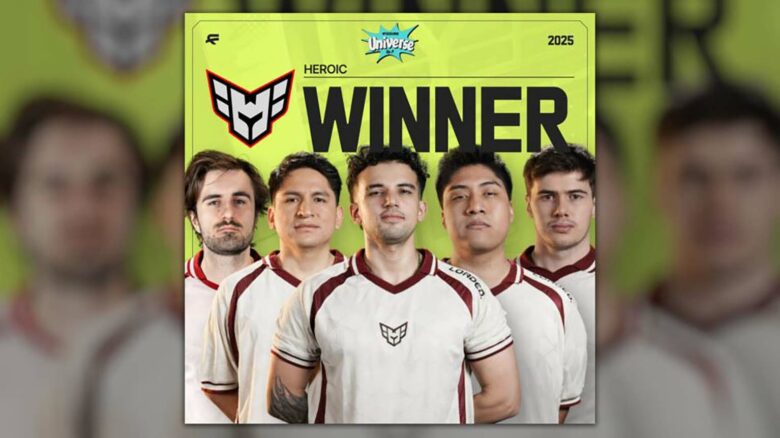
The period following The International often sparks major shifts across the Dota 2 scene as teams adjust their rosters and strategies. HEROIC followed this familiar pattern after finishing among the top six at The International 2025, opting for a series of roster changes that quickly proved effective. Their restructured lineup showed strong form, culminating in a decisive 3–1 victory over MOUZ to claim the FISSURE Universe Episode 7 title.
HEROIC’s path to the championship demonstrated consistency and composure. They overcame strong opponents such as Aurora Gaming and Team Liquid before meeting MOUZ in the final. Although the event carried a Tier 2 designation, its participant pool included several accomplished players, adding weight to HEROIC’s accomplishment and signaling a promising direction for the team’s future.
Game 1: MOUZ Demonstrated Their 2-0 Victory Over Liquid
MOUZ controlled the first game with precise coordination and strong lane execution. Wisper’s Puck struggled to gain momentum as MidOne’s Monkey King consistently pressured the mid lane and denied early farm. This advantage allowed MOUZ to dictate the pace from the start.
Their lineup—featuring Clockwerk and Snapfire—used mobility to secure map control and limit Liquid’s responses. The team’s rotations were efficient, and their objectives came quickly. Within roughly 30 minutes, Liquid conceded after failing to create space for Ursa to recover.
Game 2: An Off-Laner Steps Into Mid
HEROIC surprised everyone by placing Enigma in the mid-lane—a hero usually reserved for the off-lane. This move caught MOUZ off guard, as Enigma’s early presence disrupted their tempo and forced constant defensive rotations.
The draft’s twist didn’t end there. HEROIC shifted Queen of Pain into the carry role and added Night Stalker, whose silence and vision control neutralized Puck and Pudge.
| Hero | Role | Key Impact |
|---|---|---|
| Enigma | Mid | Early lane pressure, teamfight control |
| Queen of Pain | Carry | Burst damage and mobility |
| Night Stalker | Off-lane | Vision dominance, silencing core heroes |
The coordination and lane swaps gave HEROIC full control, turning Game 2 into a measured but decisive victory.
Game 3: A comeback to remember
MOUZ opened the third match with a strong draft built around Pudge, supported by Chen and Dawnbreaker for healing and control. Their plan worked early, keeping their lineup alive through heavy skirmishes. By the midgame, MOUZ held an 11,000 gold lead, and HEROIC looked cornered.
At the 36-minute mark, the momentum shifted. A coordinated move by Tusk and Axe pulled Crystallis into a disadvantageous position near the high ground. The misstep triggered a chaotic fight that HEROIC exploited. Scofield repeated similar initiations, turning pressure into opportunity and guiding HEROIC to claim their second win of the series.
Game 4: No One Seems to Know Who’s Playing What
HEROIC entered the fourth game with a confident draft that confused spectators and opponents alike. The team positioned Queen of Pain in the mid lane and once again relied on Cedric „Davai Lama“ Deckmyn’s Night Stalker to control the map.
By the 32-minute mark, the scoreboard showed 28–7 in kills and a 14K net worth advantage. Every player contributed effectively, but Wisper drew the spotlight with his precise execution and lane dominance.
| Player | Hero | Key Impact |
|---|---|---|
| Wisper | Queen of Pain | Mid control, burst damage |
| Davai Lama | Night Stalker | Vision, initiation |
Analysts noted that even veteran figures compared Wisper’s style to elite mid players, recognizing his growing mastery of the role.
Key Adjustments Behind HEROIC’s FISSURE Universe Episode 7 Victory
HEROIC’s success at FISSURE Universe Episode 7 followed a period of internal restructuring. The team parted ways with João “4nalog” Santos, ending a long partnership that had defined their mid-lane dynamic. In a bold shift, Wisper transitioned from the off lane to mid, marking his first major role change since his professional debut in 2017. This adjustment required the squad to rebuild its coordination and redefine its drafting philosophy around Wisper’s versatile hero pool.
The coaching staff, led by Igor “kaffs” Estevão, faced strong criticism from fans after the roster shuffle. Community backlash intensified when Davai Lama rejoined the team, reviving memories of his past conflict with former carry David “Parker” Nicho Flores. Despite skepticism, the organization stood by its decisions, emphasizing performance over public opinion. The internal trust between players and staff became a key factor in stabilizing the roster.
Roster and Role Overview
| Player | New / Current Role | Notable Change |
|---|---|---|
| Wisper | Mid Lane | Shifted from Off Lane |
| Davai Lama | Off Lane | Rejoined after prior conflict |
| kaffS | Head Coach | Oversaw transition and strategy |
These structural changes reshaped HEROIC’s playstyle. The team adopted a more flexible approach, allowing faster adaptations during drafts and mid-game rotations. Their renewed synergy became evident in the playoffs, where they dropped only one map en route to a 3–1 grand final win over MOUZ. The results demonstrated that calculated risk-taking and disciplined adjustments can yield competitive success, even under public scrutiny.