Avatar Legends: The Fighting Game shifts the series into a 2D competitive format and builds its roster around distinct mechanical identities. You choose from 12 characters at launch, including elemental benders and non-benders, each designed with dedicated systems rather than shared templates.
Gameplay Group International positions this entry as a structured fighter instead of a simple action adaptation. You manage spacing, confirm combos, and learn character-specific mechanics across modes such as Arcade, Story, Training, Online play, Combo Trials, Character Lessons, and a Gallery featuring archival artwork.
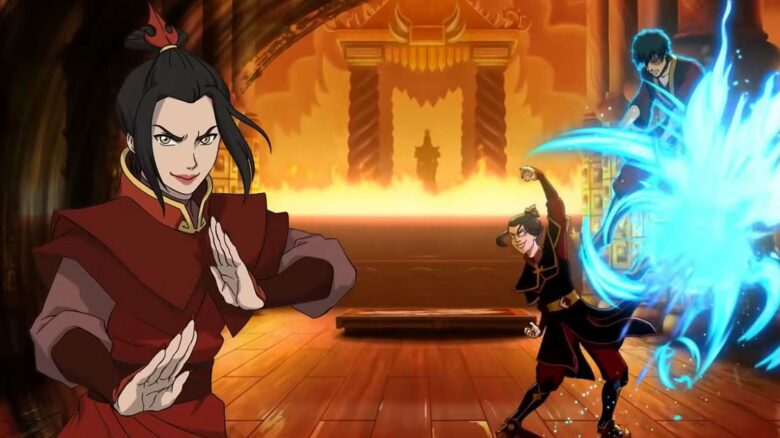
Princess Azula stands out through a dual-stance design centered on her signature blue fire and strong aerial control. You switch between two contrasting toolkits that alter her tempo, trap utility, and offensive pressure.
Sokka Uses a Distinct Combat System
Sokka breaks from the bending-focused design that defines much of the roster. You rely on weapons, timing, and movement rather than elemental projectiles or stance-based flame pressure.
Instead of chaining standard attacks into heavy finishers, you cancel most normal strikes directly into Flow moves. This system lets you interrupt offense to reposition, evade, or reset spacing almost instantly. You sacrifice traditional combo extensions in exchange for mobility and adaptability.
Key mechanical differences:
| Feature | Azula | Sokka |
|---|---|---|
| Power Source | Firebending (blue flames) | Weapons and physical skill |
| Core System | Dual modes (Focused / Firelord) | Normal-to-Flow cancels |
| Trap Game | Oil-based ignition setups | None |
| Combo Structure | Mode-dependent extensions | Limited traditional chains |
| Mobility | Strong aerial presence | Cancel-driven repositioning |
You feel that difference immediately in neutral play. With Azula, you threaten space vertically and horizontally through flame control. With Sokka, you weave in and out, forcing whiffs and punishing mistakes through timing.
Sokka’s toolkit reflects his on-screen equipment. You rotate between:
- Boomerang for ranged harassment and coverage
- Club for grounded pressure
- Meteorite Sword for sharper mid-range engagements
Each tool fills a practical role rather than adding spectacle. Without bending, you must win through positioning, reads, and efficient confirms.
By contrast, Azula operates through two defined states that reshape your approach mid-match:
- Focused State
- Controlled movement
- Calculated strikes
- Oil traps that ignite for surprise pressure
- Firelord State
- Faster, more aggressive pacing
- Expanded offensive strings
- Advancing flame attacks that push opponents backward
In Focused state, you condition opponents with placement and timing. Oil traps create delayed threats that force movement or hesitation. You dictate tempo through preparation.
In Firelord state, you trade subtlety for direct pressure. Forward-moving flame attacks compress space and encourage corner carry. Your offense becomes more volatile and momentum-driven.
Despite these contrasts, both Azula modes emphasize air dominance. You maneuver above standard ground exchanges and angle your fire attacks to control approach paths. This vertical presence separates her from more grounded fighters.
Sokka does not compete in the air the same way. You stay nimble through cancels rather than aerial superiority. That design forces you to think differently about engagement ranges and escape routes.
Because of these differences, matchup knowledge becomes essential. You cannot apply the same pressure strings across the cast. Sokka rewards precision and reaction speed. Azula rewards state management and spatial control.
The broader roster follows this philosophy of mechanical separation. While many fighters wield elements, they do not share identical systems. Each character introduces a specific structure you must learn rather than a variation of a common template.
At launch, you explore these systems across multiple modes:
- Arcade Mode for structured runs
- Story Mode for narrative-driven encounters
- Training Mode for lab work
- Online Modes for competitive play
- Combo Trials for execution practice
- Character Lessons for guided mechanics breakdowns
- Gallery Mode for franchise artwork
The Standard Edition releases on July 2 for PlayStation 5, Xbox Series X/S, PC, Nintendo Switch, and Switch 2 at $29.99. You gain access to the full 12-character launch roster and all core modes.
Azula and Sokka demonstrate how the game avoids uniform design. You adapt your strategy based on internal systems, not just visual style. That structural variety defines how matches unfold and how you develop long-term mastery.